Owners, Customers,
and the Train We
Cannot Yet Ride
A democracy becomes brittle when people pay as owners but encounter government as customers.
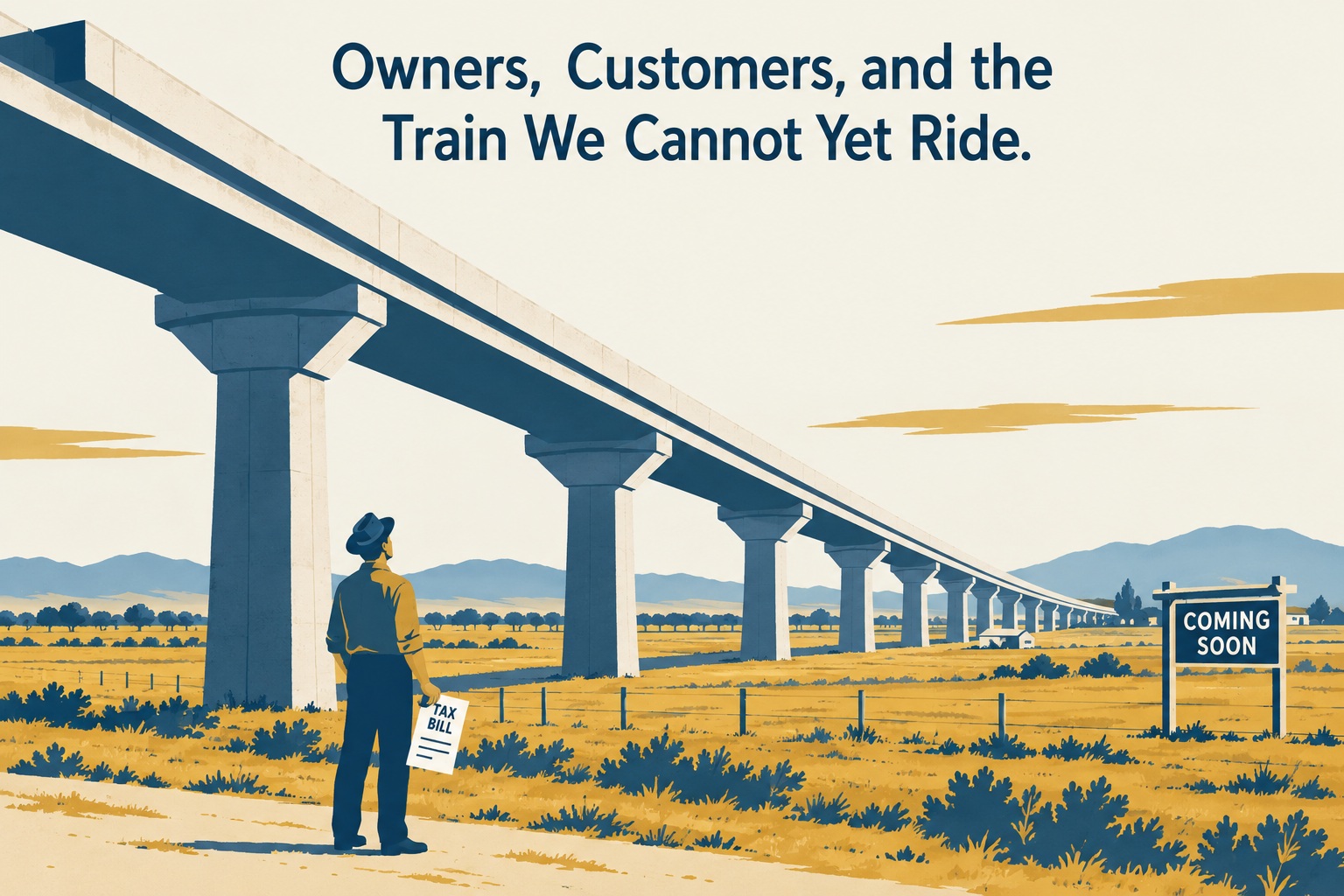
California's political resentment is usually described as anti-tax, anti-government, or anti-Sacramento. Those labels miss the source.
Californians finance a vast public order through taxes, utility bills, and rents inflated by scarcity. What they get back often feels like a service desk: a portal, a waitlist, a contractor, and no one clearly responsible when the service never arrives.
People are right to resent that.
The right proposes cuts, privatization, and deregulation, and presents the result as efficiency. The managerial center offers another task force, another dashboard, and another promise that delivery sits just past the next planning horizon. Neither confronts the central problem: California lacks the democratic capacity to turn public money into common goods people can use and hold someone accountable for delivering.
The public owns what it pays for only when it controls the essential assets and standards; when data and operations are transparent; when land-value gains created by public investment return to the public; when private partners carry real risk; and when responsibility is visible enough that decision-makers can be replaced when delivery fails.
The HSR test
California High-Speed Rail makes the problem concrete.
Real work has happened. In its May 2026 status report, the Authority counted 62 completed major structures and 87 miles of completed guideway in the Central Valley. Guideway means the civil corridor: viaducts, grade separations, and earthwork. It does not yet mean rails, electrification, signaling, or trains.1
In June the Authority approved a $3.5 billion contract to install tracks and systems. Track installation could begin as soon as November 30, 2026, with initial passenger service between Merced and Bakersfield targeted for the early 2030s.2 That progress deserves honest credit. It also means Central Valley residents still have no train to board, and will not for years.
Delay transfers cost to the public and opportunity to those who can wait, litigate, or profit from scarcity.
Every year without service, workers lose time and households buy cars they would not otherwise need. Meanwhile, land speculation near future stations continues on schedule.
Most people working on the project do necessary work and represent real interests. But a fragmented system can reward staying in the process more reliably than finishing the project. Delay creates its own constituency. Those with lawyers, lobbyists, or land near the route can afford to stay at the table. Participation earns its place by improving decisions. Intermediation becomes rent-seeking when its funding depends on the process continuing, and a state with too little in-house capacity invites it by routing planning through outside organizations. The process becomes more legible to consultants and donors than to the people waiting for the train.
Decision without dictatorship
A capable democracy still has conflict, and high-speed rail has had plenty, from land acquisition to litigation to shifting political support. Complexity explains delay. It cannot excuse delay indefinitely.
Democratic government must do more than convene stakeholders. It must hear conflict early, compensate affected people fairly, decide within a defined period, and build. A deadline differs from deregulation: labor and environmental standards stay in force, and the open-ended wait ends.
The alternative to paralysis is centralized responsibility under democratic control.
No institution holds an unlimited right to delay the common good, and consultation that never produces a decision fails the people it claims to include. A public authority needs a clear mandate, the in-house skill to carry it out, visible costs and schedules, and named officials the public can remove when delivery fails. Without those, centralization becomes unaccountable power.
Private participation, public control
In June the Authority executed a co-development agreement with Momentum Alliance Partners, a consortium of investors, engineers, and rail operators, to evaluate private investment and public-private partnerships for future expansion.3 The consortium was the only respondent to the Authority's request for qualifications.4 A six-month evaluation phase puts the consequential choices around the end of this year.5
Private firms can build, finance, or operate parts of the system, and California has always relied on them. The question is whether business serves a democratic public plan, or whether public institutions mainly de-risk private investment and manage the fallout when promised benefits fail to arrive. Ordinary contracting pays a firm to carry a defined risk; de-risking hands that risk back to the public while returns stay private.
The ownership test applies in full. Does the public keep control of the assets, the fares, and the value created around stations? And with a single bidder, who carries the downside when no competitor was there to price it?
California needs a democratic producer state rather than a demolition crew calling itself reform: one with the skill and authority to build and operate essential systems, and the accountability to return the gains of public investment to the public.
November: more than governor
The governor's race will be presented as a contest of personalities and parties. The office matters, but so do the dozens below it, from attorney general and controller to county assessor and school board. Those offices control budgets, public property, enforcement, and schools. They decide whether public institutions operate as common goods or as channels for private influence.
Apply the ownership test to every one of them. Then keep going after the election by joining the tenant, labor, and transit groups that monitor performance and press officials to deliver.
Before casting a ballot, ask three questions:
- Who pays when California fails to build?
- Who gains while ordinary people wait?
- Who can be held responsible when the public service does not arrive?
Customers ask for better service. Owners ask these questions of the people they hire.
Sources
- California High-Speed Rail Authority, Central Valley Status Report: Executive Summary, May/June 2026. The report lists 62 completed major structures and 87 miles of completed guideway, while distinguishing guideway and structures from track, signaling, siding, electrification, and communications work.
hsr.ca.gov — CVSR Executive Summary ↩ - California High-Speed Rail Authority, "California Approves Team to Build Nation's First True High-Speed Rail Track and Systems," June 1, 2026; and USA Today, "California high-speed rail turns to private investors," June 2026, on contract value and schedule.
hsr.ca.gov — Track and Systems news release
Yahoo Finance / USA Today ↩ - California High-Speed Rail Authority, "Global Infrastructure and Investment Consortium Joins California High-Speed Rail to Advance Future Expansion Through Private Investment," June 24, 2026.
hsr.ca.gov — Momentum Alliance news release ↩ - Railway Age, "CHSRA Launches Co-Development Partnership," June 2026.
railwayage.com ↩ - Progressive Railroading, "CHSRA adds Momentum Alliance Partners as codeveloper," June 25, 2026.
progressiverailroading.com ↩
Additional reading
- California High-Speed Rail Authority, 2026 Business Plan, June 2026 — hsr.ca.gov
- Sharma et al., What Holds High-Speed Rail Back: Lessons from Global Systems and California, Mineta Transportation Institute, 2026 — transweb.sjsu.edu
- "Governance, contracts, and culture: A triadic approach to megaproject performance," Project Leadership and Society (2025) — sciencedirect.com